
 Dr. Adebunmi Adeola Akinbo

Have you ever wondered how typing a website name like “google.com” or “wikipedia.org” into your browser instantly connects you to the correct website, no matter where you are in the world? Behind this seamless daily experience is a complex, global infrastructure coordinated by a single, vital non-profit organization: ICANN (Internet Corporation for Assigned Names and Numbers).
Founded in 1998, ICANN is a multistakeholder group responsible for keeping the internet secure, stable, and interoperable. Often described as the “address book” or the “traffic controller” of the internet, ICANN’s work ensures that the global network functions as one single, cohesive system.
What Exactly Does ICANN Do?
To understand ICANN’s role, it helps to understand how the internet is organized. Computers connect with each other using numbers called IP (Internet Protocol) addresses (e.g., 192.0.2.1). Because strings of numbers are hard for humans to remember, the Domain Name System (DNS) was created to translate those numbers into readable names like example.com.
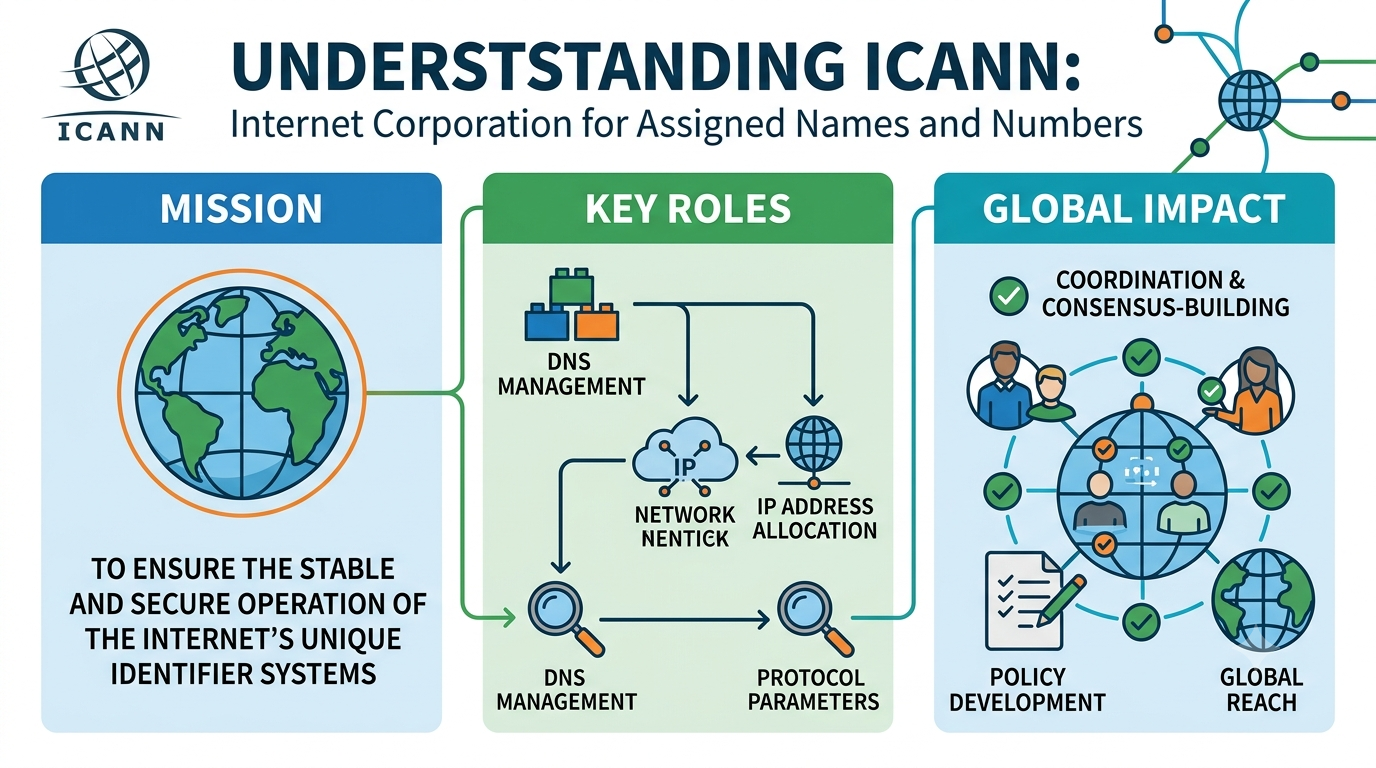
ICANN coordinates these unique identifiers globally. Its core responsibilities include:
- Managing the Domain Name System (DNS): ICANN oversees the technical coordination of the DNS. This includes defining policies for top-level domains (TLDs)—both generic ones like
.com,.org, and.net, and country-code domains like.ukor.jp. - IP Address Allocation: While ICANN doesn’t hand out individual IP addresses to your home computer, it coordinates the allocation of huge blocks of IP addresses to regional registries, which then distribute them down the line.
- Protocol Parameter Management: ICANN helps maintain the registries of technical codes and numbers that allow internet protocols to communicate with each other properly.
What ICANN Doesn’t Do
Because ICANN is so central to the internet, there are many misconceptions about its power. It is crucial to note what is outside of ICANN’s scope:
- No Content Regulation: ICANN does not control what people post online, track internet traffic, censor websites, or police spam.
- No Access Control: ICANN does not provide internet access or run the physical cables that make up the web.
The Multistakeholder Model: Who Runs ICANN?
ICANN is unique because it is not run by a single government or corporation. Instead, it operates on a multistakeholder model. This means that internet policies are developed through a bottom-up, consensus-driven process involving a diverse coalition of participants:
- Governments advising on public policy.
- Technical experts ensuring engineering stability.
- Businesses and registries managing domain registrations.
- Civil society and individual internet users advocating for the public interest.
Anyone can participate in ICANN’s public meetings and working groups, making the governance of the internet’s core infrastructure a truly global, collaborative effort.
Why ICANN Matters to You
Without ICANN’s global coordination, the internet could easily fracture. Different regions might develop competing numbering or naming systems, meaning a website accessible in North America might be unreachable in Asia. By maintaining a single, universally recognized set of identifiers, ICANN ensures that the internet remains a unified global resource for communication, commerce, and connection.