 Dr. Adebunmi Adeola Akinbo

While politics focuses on the process of decision-making, government represents the institution and structure that carries out those decisions. To understand a government, we must examine its blueprint, which can be broken down into three core components: its structure, its primary functions, and how citizens interact with it.
The Architecture of Governance
A government’s design is dictated by its core structure and the principles it is built upon. This is the foundation of public order.
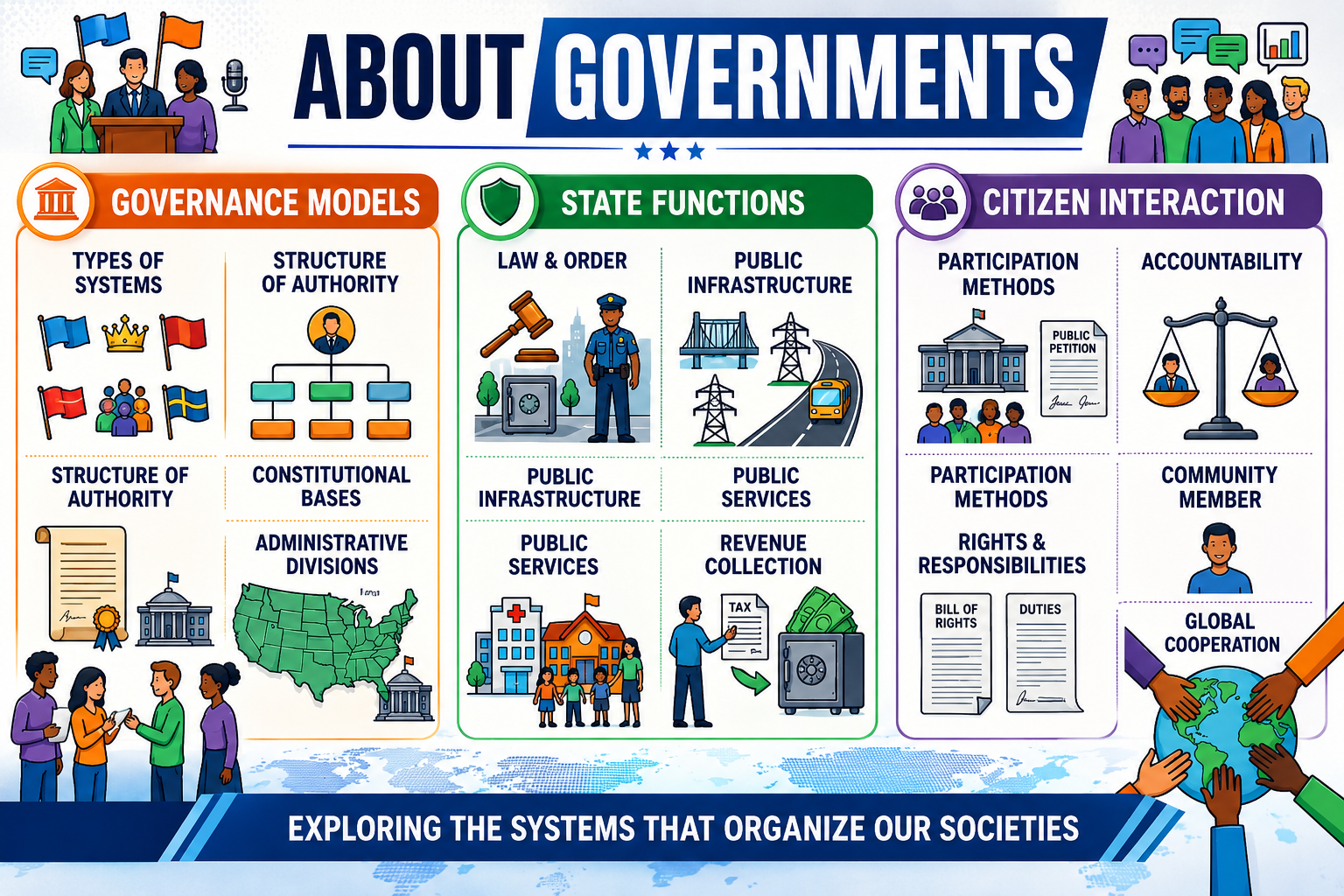
- Governance Models: This section (see graphic, left column) details the overall type of government (e.g., Democracy, Monarchy, etc.) and how authority is formally established.
- Structure of Authority: The infographic visually charts the power flow, from the highest levels (like a Head of State) down through ministries and departments.
- Constitutional Bases: All state action is rooted in a foundational document. The graphic uses a sealed scroll to symbolize the fundamental laws and constitutions that define and limit government power.
- Administrative Divisions: The diagram of a nation divided into provinces or states shows how central authority is distributed to local levels for efficient administration.
The State in Action: Core Functions
Beyond its structure, the purpose of a government is to perform essential functions that maintain the stability and quality of life for its people. The infographic’s center column focuses on these core state actions.
- Law & Order: Using a judge’s gavel and a police officer, this illustrates the state’s monopoly on the legitimate use of force to enforce rules and ensure safety.
- Public Infrastructure: Governments build and maintain critical systems—from dams and power grids to roads and public transport—which are the backbone of a modern economy.
- Public Services: This element shows the essential services a government provides to its people, including health (represented by a hospital) and education (a school with diverse children).
- Revenue Collection: Essential to all other functions, this illustrates how resources (taxes) are collected to fund the public good.
The Citizen Connection
The relationship between a government and its people is dynamic. A legitimate government requires interaction and accountability. The right column of the infographic focuses on this vital connection.
- Participation Methods: Citizens engage through voting, town hall meetings, and petitions, illustrating that government is, in varied ways, responsive to the popular will.
- Accountability: The scale of justice balancing a citizen with a government official represents the mechanisms—from legal systems to independent audits—that ensure state actors are answerable for their actions.
- Rights & Responsibilities: The dual nature of the relationship is symbolized by a scroll with “Bill of Rights” on one side and “Duties” on the other, reflecting the balance between personal freedom and civic obligation.
- Global Cooperation: In a connected world, governments act as representatives on the global stage. Diverse hands holding a stylized globe show how states work together on international agreements and shared challenges.
This article and its corresponding infographic provide a clear and structured overview of the systems that organize our societies, differentiating between the political process and the institutional structures of governance.