
 Dr. Adebunmi Adeola Akinbo
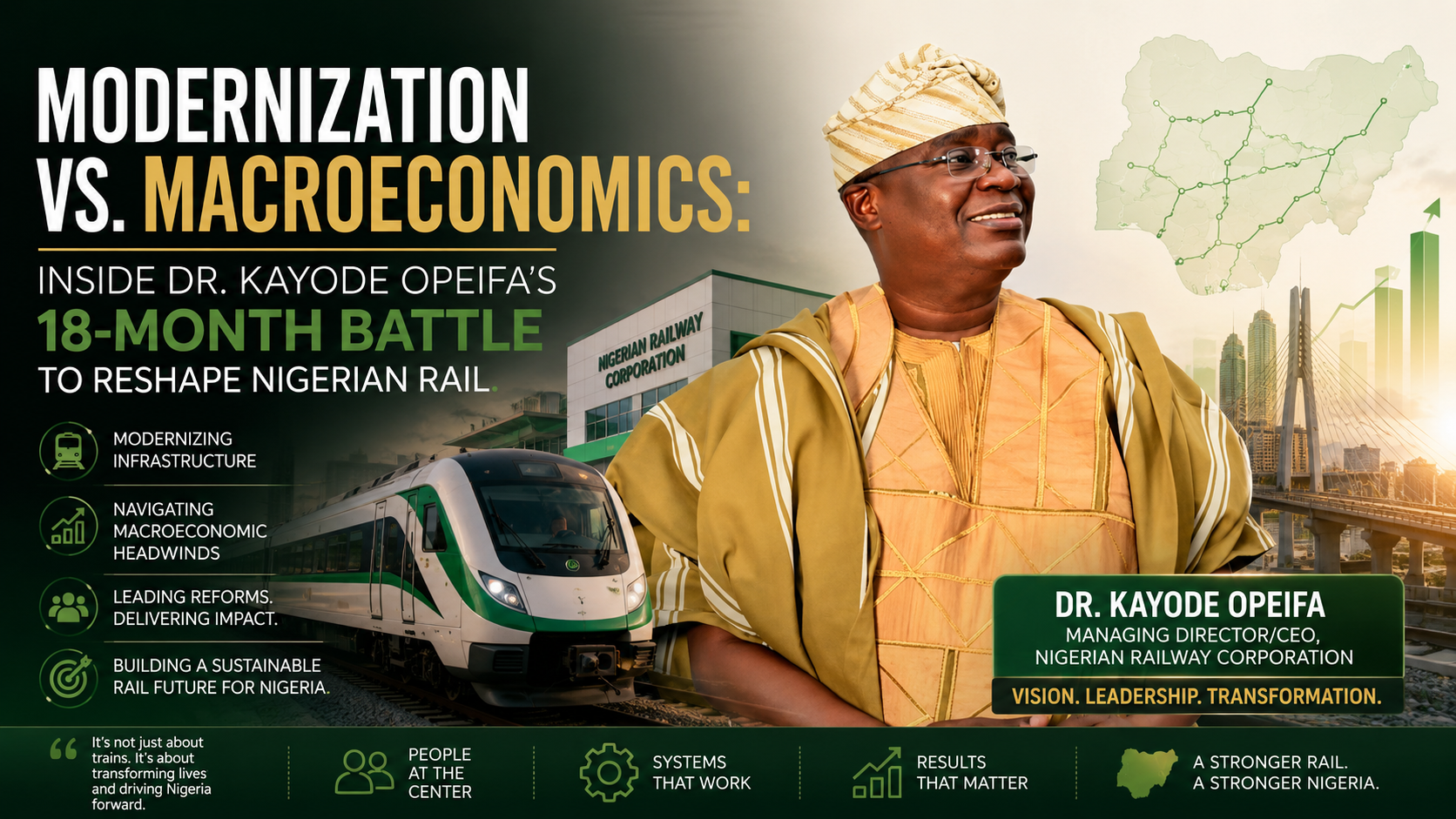

ABUJA — Eighteen months after taking the helm at the Nigerian Railway Corporation (NRC), Managing Director Dr. Kayode Opeifa’s administration finds itself at a critical crossroads. An analysis of his tenure since January 2025 reveals an ambitious transitional phase focused heavily on infrastructure modernization, a commercial “cargo revolution,” and aggressive structural reforms—all balanced against crushing macroeconomic headwinds.
Inheriting a passive public utility, Opeifa has spent the last year and a half attempting to reposition the NRC as a strategic engine for national trade. However, as the corporation battles severe financial distress, the ultimate success of his tenure remains tethered to a high-stakes race between long-term electrification plans and immediate inflationary pressures.
The Strategic Shift: Multi-Decade Roadmaps and State Alliances
Upon taking office, Opeifa introduced the “Vision 2-5-10-20” Roadmap, a multi-decade blueprint designed to radically overhaul Nigeria’s rail architecture. The plan outlines a aggressive timeline: optimizing national rail assets within two years, transitioning fully to electric traction within five years, doubling network capacity in ten years, and expanding the nationwide network to a staggering 60,000 kilometers within twenty years.
Concurrently, Opeifa has capitalized on recent constitutional amendments that moved railways from the exclusive to the concurrent legislative list. Under the banner of “railing with the states,” the NRC has aggressively pursued sub-national integration. This policy has allowed states like Lagos and Plateau to leverage national rail corridors at no extra cost, effectively integrating local metro networks with federal infrastructure to create a more seamless transit web.
The ‘Cargo Revolution’ and Line Reactivation
With passenger services heavily exposed to economic shocks, Opeifa’s administration has pivoted sharply toward commercial freight to drive revenue and lower national logistics costs.
By prioritizing direct rail connections to primary economic corridors and major ports, the NRC has successfully boosted its commercial cargo volumes. A landmark agreement with multinationals like APMT now sees containers moving thrice weekly from Apapa Port to Moniya in Ibadan via the standard gauge line. Freight operations have also diversified into heavy industry, with the NRC actively transporting cement, gypsum, soda ash, and critical materials for the AKK Pipeline Project.
This freight expansion has been supported by the systematic reactivation and repositioning of key routes across both narrow and standard-gauge networks, including:
- The Lagos–Kano–Baro narrow gauge
- The Abuja–Kaduna service
- The Lagos–Ibadan corridor
- The Warri–Itakpe industrial line
Restructuring and Preparing for Unbundling
Internally, Opeifa inherited an enterprise plagued by low employee morale and stagnant institutional structures. To revitalize the workforce, the administration approved a 95% salary payout implementation alongside enhanced welfare packages. Furthermore, modern vocational training programs have been embedded within the NRC, equipping staff with technical skills in solar technology, specialized mechanics, and advanced welding.
These internal changes serve a larger, mandated purpose. Tasked by the Presidency to break the decades-old public enterprise monopoly, Opeifa’s leadership is driving strict accountability measures to prepare the NRC for unbundling. The corporation is actively being restructured into separate, specialized corporate entities designed to attract private investment and foster competition.
The Diesel Crisis and Financial Bottlenecks
Despite these operational milestones, the reality on the tracks remains perilous. The NRC continues to operate at a heavy financial loss, relying heavily on borrowing to sustain its basic day-to-day operations.
The greatest threat to Opeifa’s vision is the ongoing diesel crisis. The hyper-inflationary cost of diesel fuel has become a massive operational bottleneck, consuming an overwhelming percentage of the corporation’s revenue. This fuel spike has made regular passenger train schedules highly inefficient and expensive to maintain, perfectly illustrating why the administration is treating its five-year electrification roadmap as an existential necessity rather than a distant goal.
Mid-Term Verdict
Eighteen months in, Dr. Opeifa has successfully altered the DNA of the NRC, shifting it from a sleepy public utility into an active participant in regional trade and state-level transport. Yet, the systemic challenges ahead are formidable. Whether history views his tenure as a success depends entirely on his ability to execute the federal unbundling mandate and transition the network away from expensive diesel dependency before macroeconomic realities derail the tracks entirely.