 admin
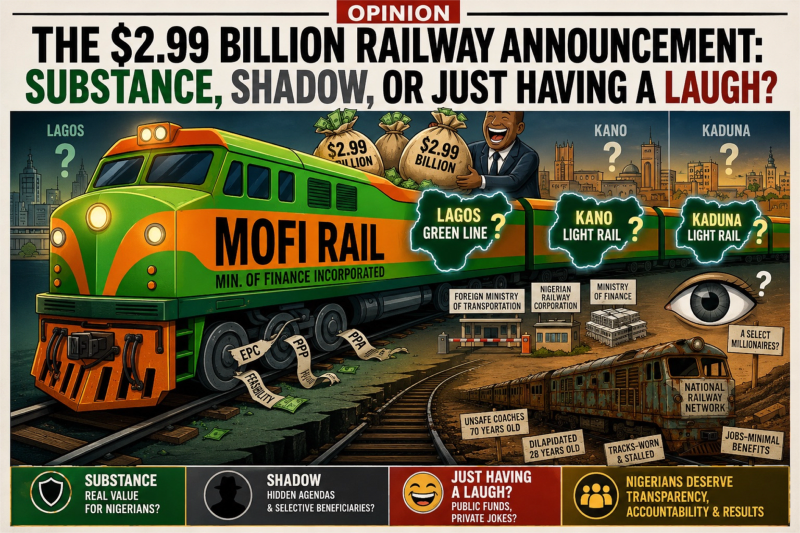

The recent announcement from the Federal Executive Council (FEC) approving a staggering $2.99 billion for light rail projects across Lagos, Kaduna, and Kano should ideally be a moment for national celebration. On paper, it sounds like the dawn of a transport revolution. But as with most things in Nigeria’s policy space, the devil isn’t just in the details—the devil is in the total, absolute absence of them. My flab is thoroughly aghasted by the sheer hollowness of what our media houses happily put out and called “news.”
Look at the reporting. We are told the Ministry of Finance Incorporated (MOFI) will sponsor these contracts for the Lagos Green Line, Kano metro rail, and Kaduna rail. Nothing more, nothing less.
Where is the basic journalistic curiosity? Who were these massive contracts awarded to? What is the specific scope of work? Is the procurement route traditional, turnkey, Engineering, Procurement, and Construction (EPC), or a Public-Private Partnership (PPP)? What is the project duration? We are given a multi-billion-dollar headline with zero substance, and the media blindly prints it without asking a single question.
The Problem of Sovereign Overreach and Abandoned Tracks
Beyond the lack of transparency, the substance of the announcement raises profound constitutional and economic contradictions. Why is the Federal Government (FG) purveying and investing heavily in sub-national intra-city railways?
Following the landmark 2023 constitutional amendment, states have been fully empowered to build, manage, and operate their own railway networks. Concurrently, these states are reportedly receiving larger allocations from the federal federation account than ever before. While inter-governmental collaboration isn’t inherently bad, we must look at the track record of the benefactor.
The same FG pushing into state rail systems has proven incapable of funding its own federal network. Look at the Abuja Light Rail: a 19-year saga where only the first two lots out of six have seen completion. Nationally, the FG sits on an unfunded mountain of outstanding railway contracts exceeding $20 billion. Consider the laundry list of abandoned or stagnant projects:
- The Lagos-Calabar Coastal Rail: First awarded in 2014, yet to see a single shovel hit the ground.
- The Ibadan-Abuja Rail: First awarded in 2006, still a mirage.
- The Itakpe-Abuja Extension: Awarded in 2020, yet to start.
- The Baro-Minna Line and Port Harcourt-Maiduguri Rehabilitation: Both awarded in 2019 and going nowhere fast.
How can an administration that cannot fund its own sovereign master plan justify taking on $3 billion in localized light rail liabilities? It begs incredulity.
History Repeats Itself: The Sidelining of Technical Expertise
Perhaps the most worrying structural red flag is the choice of vehicle. The FG has effectively sidelined its primary technical organs—the Federal Ministry of Transportation (FMT) and the Nigerian Railway Corporation (NRC)—in favor of MOFI.
What technical capacity does MOFI possess to design, oversee, or execute complex urban rail infrastructure? Zero. It is an investment vehicle, not an engineering entity.
We have watched this tragic movie before. In 1983, the Itakpe-Ajaokuta-Warri railway was originally awarded under the Ministry of Mines and Power, which had never built a mile of track. In 2006, President Obasanjo awarded the $8.3 billion Lagos-Kano railway and curiously domiciled it within the Office of the Secretary to the Government of the Federation (OSGF). Unsurprisingly, both projects stalled for decades until they were eventually transferred back to the FMT, where the actual railway engineers reside.
Now, history is repeating itself. MOFI is reportedly receiving more budgetary appropriation for railways than the FMT and NRC combined. To add to the absurdity, rumors are filtering out that the OSGF is currently reviewing proposals for a High-Speed Rail (HSR). Are we serious as a nation, or are we just having a laugh?
When the FG wants to collaborate properly with states, it knows what to do. The Lekki Deep Sea Port is a prime example of purposeful, transparent collaboration: the FG, the Lagos State Government, and a private operator sat at the table, with the FG’s technical interests appropriately represented by the Nigerian Ports Authority (NPA). Why abandon this tested blueprint?
Outdated Studies and the Myth of the Rail PPP
We must also look at the reality of what is being built. The Lagos Green Line likely possesses the most viable framework, given recent African Development Bank (AfDB) grant interventions, which usually enforce strict due process. However, Kaduna’s rail study was conducted by Systra back in 2017 during the El-Rufai administration—rendering it deeply out of date. Kano’s study dates back even further to the NIAF2 project during Kwankwaso’s second gubernatorial term, a literal lifetime ago in economic and demographic terms.
Furthermore, these projects are being loosely branded as “PPPs” (Public-Private Partnerships) with government-owned infrastructure and private operators. But let’s call a spade a spade: our rail PPPs historically unravel into glorified, government-funded management contracts dressed up in fancy terminology. The Lagos Blue and Red lines, as well as the Abuja Light Rail, have largely followed this exact script.
When the government absorbs 100% of the financial and operational risk while masking it as a PPP, it severely limits the long-term capacity, efficiency, and sustainability of the system. Yet, because we live in a society that chronically settles for mediocrity, the political vuvuzelas and tailored data point specialists are instantly rolled out to loud-hail these unsustainable outcomes as monumental achievements.
A Call for Journalistic Awakening
This brings us back to the gatekeepers of our public discourse. Why is our media so eager to regurgitate government press releases without interrogating the math, the mechanics, or the institutional logic? Whose interest do they really serve when they fail to ask why a political office or financial holding company is executing railway tracks while specialized engineers sit idle?
Too many things are failing to make sense in Nigeria’s railway space. It is a confusing maze of overlapping mandates, abandoned debts, and sudden multi-billion-dollar announcements. Hopefully, independent minds will begin to demand real answers. Until then, we can only watch this space, hoping we eventually wake up to find our transport policy was just a strange dream—and not an expensive, generational nightmare.
Supporting Source and Credit: https://www.linkedin.com/feed/update/urn:li:activity:7456224025464467456/

 Dr. Adebunmi Adeola Akinbo