

 admin
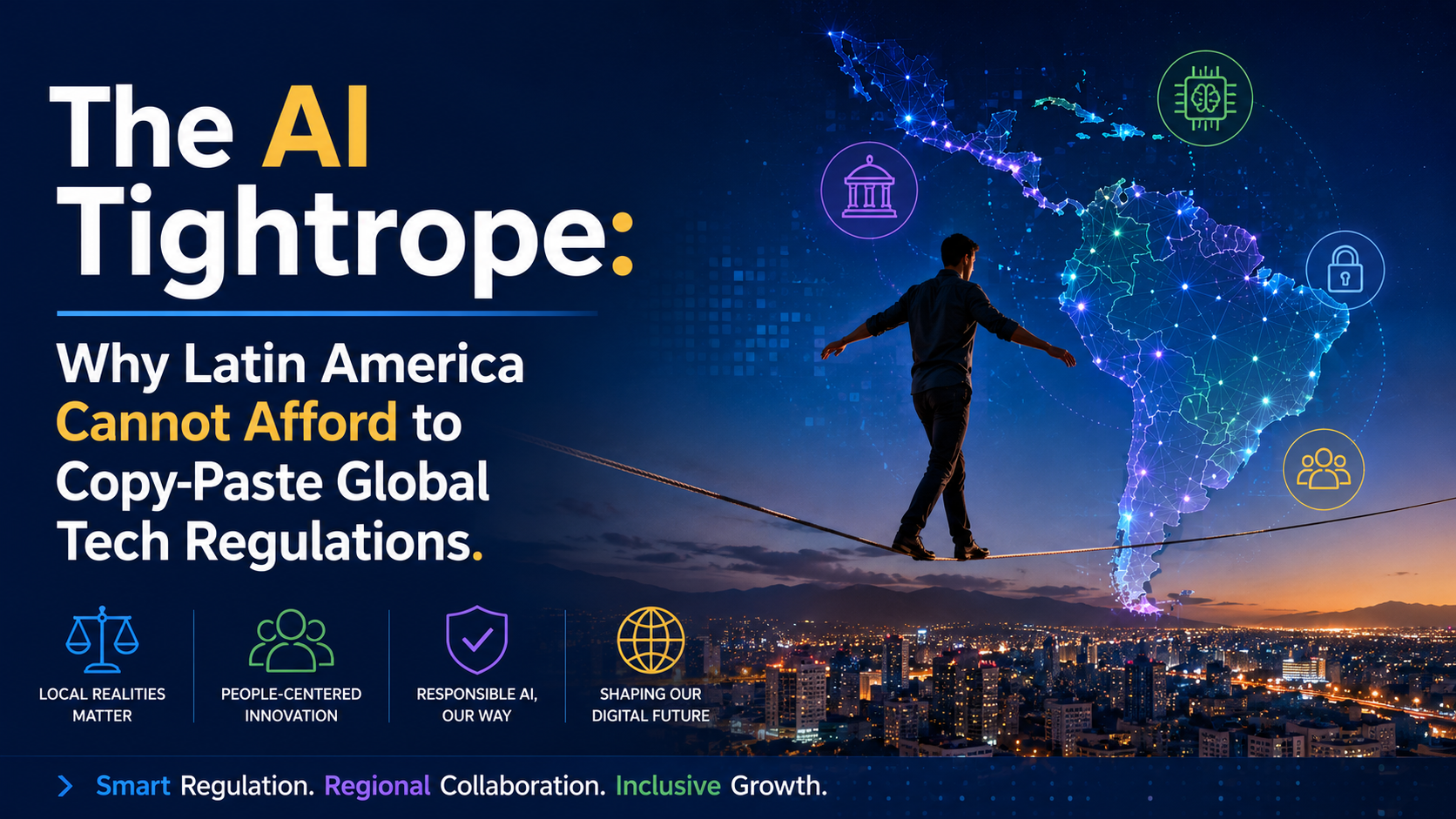

As delegates gather at the CAF headquarters in Montevideo for the 2026 Latin America and Caribbean Digital Communications and Media Forum, a familiar shadow hangs over the agenda. For decades, the region has struggled to close the digital divide and bridge infrastructure funding gaps. Now, a new, faster-moving challenge threatens to widen those existing inequalities: the governance of Artificial Intelligence.
The dilemma facing Latin American policymakers is distinct. On one hand, AI offers unprecedented tools to leapfrog development hurdles, optimize resource management, and supercharge the regional creative economy. On the other hand, the regulatory risks are massive. If the region moves too slow, it risks becoming a mere data colony for global tech giants. If it moves too fast or blindly copies heavy-handed foreign frameworks, it risks suffocating the fragile local innovation it desperately needs to foster.
To date, the global conversation on AI regulation has been dominated by two competing philosophies. The European Union’s Brussels-style framework relies on a stringent, risk-based compliance model that places heavy bureaucratic burdens on developers. Conversely, the United States has favored a market-led, decentralized approach that prioritizes rapid deployment.
For Latin America, adopting either model wholesale would be a policy failure.
The region’s digital ecosystem is fundamentally different from those of the Global North. It is driven heavily by small and medium-sized enterprises (SMEs) and a vibrant but vulnerable local media sector. Enacting a carbon copy of the EU’s regulations would inadvertently crush local tech start-ups under the weight of compliance costs they cannot afford, effectively cementing the monopoly of foreign big-tech firms who have the legal capital to navigate complex rules.
Furthermore, the societal stakes of unregulated AI are uniquely magnified in the region. As highlighted at the Media Forum, the intersection of AI with online safety and digital literacy is a pressing vulnerability. In a region where political polarization runs high and digital literacy is uneven, AI-driven disinformation campaigns pose a systemic threat to democratic stability. Automated systems deployed without local contextual training risk reinforcing systemic biases, misinterpreting regional linguistic nuances, and further marginalizing vulnerable or indigenous populations.
Therefore, the path forward requires an approach tailored specifically to the realities of Latin America and the Caribbean.
First, regulatory frameworks must be agile rather than prescriptive. Policymakers should utilize regulatory sandboxes—controlled environments where local AI start-ups can test innovations under relaxed regulatory scrutiny while regulators observe risks in real time. This protects the public while allowing local technology to mature.
Second, AI policy cannot be divorced from infrastructure reality. You cannot build a sovereign AI ecosystem without data centers and connectivity. Regulatory frameworks should incentivize foreign tech investment in local infrastructure—such as the data centers discussed in Montevideo—while ensuring that regional data remains subject to strong local privacy protections.
Finally, governance must be multi-stakeholder. Governments must resist the urge to dictate AI policy behind closed doors. Tech leaders, civil society, and local media representatives must have a permanent seat at the table to ensure rules protect cultural industries and local content creation from being cannibalized by global algorithmic models.
Latin America stands at a critical juncture. The Montevideo forum reminds us that digital transformation is a continuous struggle for inclusion. If local leaders fail to craft an independent, balanced AI regulatory framework, the digital divide will no longer just be about who has an internet connection—it will be about who commands the algorithms that shape regional reality.


 Dr. Adebunmi Adeola Akinbo